For parents · 9th grade · 2026–27
College planning in 9th grade: a parent’s checklist.
Yes, 9th grade counts. Colleges see every grade from freshman year on, and in Georgia the HOPE GPA includes 9th-grade core classes. You don’t need test prep or a college list yet. This year is for a sound schedule, good study habits, two or three activities your teen likes, and a summer that’s more than screens.
By Lokesh Pampatti, founder of Clarity Prep · Updated November 15, 2026
Freshman year is the easiest year to get right and the easiest to overdo. The goal isn’t a résumé. It’s a student who leaves 9th grade with solid grades, a schedule that keeps doors open, and a sense of what they enjoy.
Why 9th grade counts
The high school transcript starts now. Every course and final grade from 9th grade on goes into the record colleges read, and the GPA your teen carries into senior year is built from these early semesters too. A 9th-grade B is hard to average away later.
That isn’t a reason to panic. Admissions readers look for a trend. A student who stumbles in the fall of 9th grade, figures out how to study, and climbs from there tells a good story. What hurts is a pattern of avoidable low grades, or a schedule that closes off harder classes later.
Course choices
The 9th-grade schedule matters most for what it leads to. A few choices now decide what’s possible in 11th and 12th grade.
- Math. Math runs in a sequence, so the 9th-grade course sets the path. Ask the school which course leads to calculus by senior year, and whether that path makes sense for your teen. Don’t skip ahead if the basics aren’t solid.
- World language. Start one now if you can, and plan to stay with the same language for at least three years. Colleges count years of language, and a long run in one language keeps the most options open.
- Science and English. Take the honors level where your teen is ready and the school recommends it. Honors in a strong subject beats honors everywhere.
- Electives. Use one slot for something your teen is curious about. Interests often start in an elective.
Sketch all four years once, roughly, with the course planner, then revisit it each spring. The what classes to take guide explains what colleges expect, and AP vs. IB vs. dual enrollment covers the advanced options for later years.
Grades and habits
The jump from middle school is real: more homework, less reminding, teachers who expect students to ask for help. What helps most in 9th grade is boring and it works:
- A planner or calendar your teen actually uses, checked at the same time every day.
- A set time and place for homework.
- Asking a teacher for help the first week a grade slips, not the last week of the semester.
- Checking the online gradebook together once a week for the first quarter, then less as things settle.
Teachers matter beyond grades. In 11th grade your teen will likely ask a teacher or two for recommendation letters. Students who speak up in class and visit office hours from the start make that ask easier. See letters of recommendation for how it works later.
Activities
Fall of 9th grade is the time to try things: a club, a sport, music, a service group, a job at home or for a neighbor. By spring, help your teen pick the two or three they want to keep. Depth over four years tells colleges more than a long list from one year.
Start a simple running list now, in a shared note: the activity, the dates, roughly how many hours a week, and anything they did or led. In senior year, the application asks for exactly this, and almost nobody remembers 9th grade accurately three years later.
Service counts too, especially when it’s steady. The volunteer opportunities page lists options by area.
The summer after 9th grade
Aim for one or two things with some substance, not a packed calendar. Good options:
- a part-time job, even a small one
- regular volunteering
- a class or camp in a subject they enjoy
- a project they make or run themselves
- caring for siblings or helping with a family business
Add reading for pleasure. It helps with every future test and essay. If you’re looking at programs, the summer programs list is a place to start. A pricey program isn’t needed to look good to colleges.
What not to do yet
- No test prep frenzy. Some schools give the PSAT 8/9 in the fall testing window (October 1–30 in 2026). It needs no prep. Use the score report to spot gaps, then go back to schoolwork.
- No college list. Visiting a campus on a family trip is fun and useful. Ranking dream schools at 14 adds pressure without helping.
- No stacking hard classes for the transcript. Five honors classes and a C average is worse than two honors classes and A’s.
- No paying for “résumé building.” Bought activities rarely impress anyone. Your teen’s own interests are enough.
- No talking about college every night. Short, regular check-ins work better than long lectures.
If 9th grade is going badly
Many students have a rough first semester. If report cards come home with a D or F, act fast and stay calm. Meet the teacher first and ask one question: what would it take to raise this grade? Then check whether the problem is the class level, missing work, or something outside school like sleep, stress or a friendship.
Moving down a level mid-year can be the right call when a class is clearly too hard. A strong grade in a standard class serves your teen better than a failing grade in honors. Ask the school counselor about options, including summer or credit recovery courses if a class is failed. In Georgia, remember that every attempt of a repeated course counts in the HOPE GPA, so the goal is to fix the grade the first time when possible.
How to talk about it at home
Keep college out of most conversations this year. Ask about classes, friends and what was interesting today. When you do talk about the future, ask questions instead of giving answers: what subjects feel easy, which teachers they like, what they’d try if nobody was watching. Those answers point toward courses, activities and, years from now, colleges.
Georgia notes
If you live in Georgia, the HOPE GPA is worth understanding now, because 9th grade counts in it. From GAfutures:
- It uses core classes only: English, math, science, social studies and foreign language.
- Grades from 9th through 12th grade count, converted to a 4.0 scale.
- Honors classes get no extra weight.
- AP, IB and dual enrollment core classes add half a point, but only to grades of B, C, D or F. An A stays a 4.0.
- If a course is repeated, every attempt counts. A retake doesn’t erase the first grade.
- The HOPE GPA is never rounded. A 2.99 is not a 3.0.
The HOPE Scholarship needs a 3.0 HOPE GPA at graduation plus four rigor credits from the state’s course list. After 9th grade, your school sends grades to the state (underclass data is due by September 1), and your teen can check the HOPE GPA in their GAfutures account from 10th grade on. Set up that account together. The HOPE guide covers Zell Miller and the rigor list, and Georgia graduation requirements lists the credits your teen needs to graduate.
Note the difference from colleges: the HOPE GPA and a college’s own GPA can be calculated differently. UGA, for example, uses its own formula; see how to get into UGA.
The 9th-grade checklist
| When | Your teen | You |
|---|---|---|
| August–September | Set up a planner; try two or three clubs or teams | Learn the gradebook and how to reach each teacher |
| October–November | Ask for help on any class below a B; take the PSAT 8/9 if offered | Attend conferences; meet the school counselor once |
| December–January | Look at first-semester grades and adjust habits | Start the shared activity list |
| February–March | Pick 10th-grade courses with teacher input | Check the math and language path for 11th and 12th |
| April–May | Finish strong; choose the activities to keep | Plan the summer: one or two real commitments |
| June–July | Work, volunteer, build or study something; read | Georgia: set up the GAfutures account together |
For your student
Your grades this year are the first ones colleges will see, so take them seriously, but you don’t need to have it all figured out. Ask teachers for help early. Try a few activities and keep the ones you like. Write down what you do as you go. That’s the whole job in 9th grade. Tests and college lists can wait.
Questions
Does 9th grade matter for college?
Yes. Your student’s transcript starts in 9th grade, and colleges see every year of it. In Georgia, the HOPE GPA counts core classes from 9th through 12th grade. One rough semester won’t sink anyone, but freshman grades are part of the record.
Do colleges look at freshman year grades?
Most do, because they see the full high school transcript. Some colleges recalculate GPA from certain courses or years, so check each college’s own admissions page. Either way, a rising trend after a slow start reads well.
Should my 9th grader start SAT or ACT prep?
No. Focus on reading, math class and good habits. If the school gives the PSAT 8/9, treat it as an early look at strengths and gaps, with no prep. Serious test prep usually fits best in 10th or 11th grade, after more math.
How many activities should a 9th grader do?
Try a few in the fall, then keep the two or three your teen actually enjoys. Colleges care more about steady involvement and growth over four years than about a long list from one year.
Does 9th grade count for the HOPE scholarship?
Yes. GAfutures says the HOPE GPA uses core grades from 9th through 12th grade: English, math, science, social studies and foreign language. Every attempt of a repeated course counts, and the number is never rounded.
Should my 9th grader take honors or AP classes?
Take honors in subjects where your teen is strong and ready, and the standard level elsewhere. Very few students need an AP in 9th grade. A strong start matters more than a heavy one. For Georgia’s HOPE GPA, honors classes get no extra weight.
What should a 9th grader do over the summer?
Something real for a few weeks: a job, volunteering, a project, a class they’re curious about, or helping the family. Add some reading. Expensive programs aren’t required, and colleges won’t expect a polished résumé from a 14-year-old.
Want a mentor to carry the plan with your student?
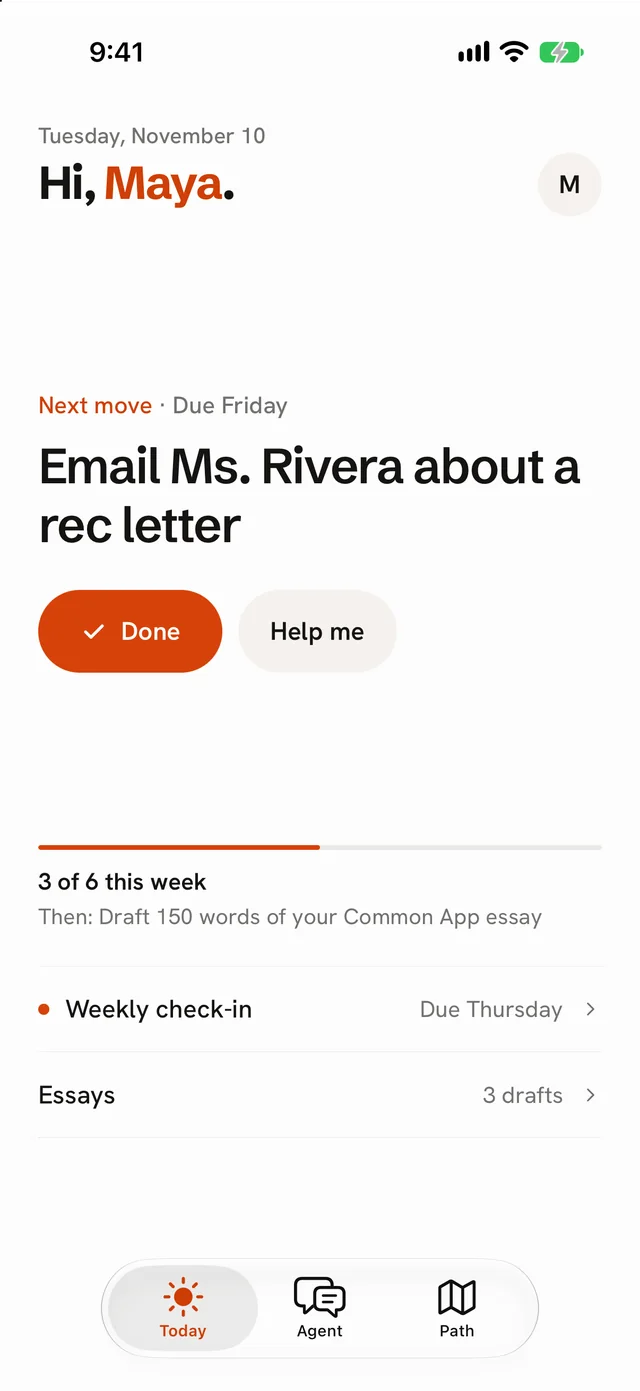
A Clarity Prep mentor meets your student every week, builds the course plan, test dates and college list, reads every essay, and keeps you in the loop, so you get to be the parent instead of the project manager. It starts with a 15-minute call with Lokesh.
Any grade: Clarity Prep AI, $49 a month, cancel anytime. 9th-11th grade with a mentor: $499 a month, cancel anytime, 10-day refund. 12th grade: the Senior Application Package, $499, one payment, through January 15. Or create an account
Sources, all checked November 15, 2026:
- GAfutures (Georgia Student Finance Commission): Understanding the High School HOPE GPA, My High School HOPE GPA, HOPE Scholarship initial academic eligibility
- College Board, SAT dates and deadlines (in-school testing windows, including PSAT 8/9)
Clarity Prep is an independent mentoring company, not affiliated with or endorsed by any college or agency named here.